Celestron Astronomy Binoculars Showdown: Choosing the Right Stargazing Power
Celestron has anchored consumer sky observation since its founding in California in 1960, building an enduring reputation for pairing astronomical aperture with accessible optical engineering. While daytime birding and hunting sports often prioritize lightweight roof prisms, specialized astronomy binoculars celestron manufactures leverage traditional Porro prism layouts to maximize light transmission and physical depth perception across…
Prices and specifications come from the Amazon listing. Ratings are the average left by Amazon buyers — this site does not test products.
Awards Worked out automatically from the Amazon listings of the 6 products in this guide — no editorial scoring.
-
Highest rated

Celestron Cometron 7x50mm Astronomy Binoculars for Wide-Field Sweeping
4.8★ average from Amazon buyers — the highest of the 6 rated in this guide
As Amazon Associates, we earn from qualifying purchases. This means we may receive a small commission at no extra cost to you if you click through and make a purchase.
Celestron has anchored consumer sky observation since its founding in California in 1960, building an enduring reputation for pairing astronomical aperture with accessible optical engineering. While daytime birding and hunting sports often prioritize lightweight roof prisms, specialized astronomy binoculars celestron manufactures leverage traditional Porro prism layouts to maximize light transmission and physical depth perception across the night sky. From sweeping Milky Way star clusters and tracking transient comets to resolving crisp lunar craters, the company designs these binoculars to gather faint photons that standard handheld optics routinely miss.
Across this visual optics lineup, Celestron differentiates each model through clear variations in objective lens diameter, optical magnification, prism coatings, and mounting requirements, spanning wide-field 50mm binoculars suited for handheld scouting up to massive 80mm light cannons that strictly mandate stationary tripod observation.
Celestron Astronomy Binoculars Compared
| Model | Objective Lens Diameter | Magnification | Exit Pupil | Water Resistance | Focus Mechanism |
|---|---|---|---|---|---|
| Celestron SkyMaster 15×70 | 70 mm | 15x | 4.7 mm | Water Resistant | Center Focus |
| Celestron Cometron 7x50mm | 50 mm | 7x | 7.1 mm | Water Resistant | Individual Focus |
| Celestron SkyMaster 25×70 | 70 mm | 25x | 2.8 mm | Water Resistant | Center Focus |
| Celestron SkyMaster 12×60 | 60 mm | 12x | 5.0 mm | Water Resistant | Center Focus |
| Celestron SkyMaster Pro 20×80 | 80 mm | 20x | 4.0 mm | Waterproof | Center Focus |
| Celestron SkyMaster 15-35×70 | 70 mm | 15x to 35x | 4.7 mm | Water Resistant | Center Focus |
Pick 01
Celestron SkyMaster 15×70 Astronomy Binoculars for Deep-Sky Stargazing

Best for: All-around deep-sky stargazing on a tripod
- Buyer rating
- 4.4 average left by Amazon buyers
- Brand
- Celestron
Pros
- Massive 70mm light gathering
- High-density BaK-4 Porro prisms
- Comfortable 18mm eye relief
- Tripod adapter rod included
Cons
- Demands tripod for steady views
- Heavy for prolonged handholding
The Celestron SkyMaster 15×70 Astronomy Binoculars stand as the benchmark optic in the manufacturer’s long-range collection, engineered specifically for night-sky exploration and extended land observation. Built around substantial 70mm objective lenses, this binocular achieves a balanced 15x magnification that brings open star clusters, bright nebulae, and lunar topography into sharp relief. Its optical train utilizes high-density BaK-4 Porro prisms and multi-coated glass elements to deliver high light throughput, making it a reliable performer during twilight, dusk, and dark-sky nighttime observation where light gathering is critical.
Mechanically, the optic relies on a durable rubber-armored housing that shields internal prism alignment against light impacts while offering a secure, slip-free grip. An eye relief of 18 millimeters pairs with a 4.7-millimeter exit pupil and a relative brightness rating of 22.09, ensuring comfortable extended sessions for both eyeglass wearers and uncorrected eyes. While visual enthusiasts can brace this binocular by hand for brief celestial passes, Celestron includes a dedicated quarter-twenty tripod adapter rod in the box because the physical size and forward-heavy weight profile demand tripod mounting for jitter-free viewing.
This model is the ideal match for amateur astronomers looking for serious deep-sky light gathering without jumping to the extreme weight of an 80mm system. It easily out-resolves smaller entry-level optics when examining faint Messier targets, but users who require full handheld freedom for quick constellation scanning will find the lighter 7x50mm platform more agile.
Pick 02
Celestron Cometron 7x50mm Astronomy Binoculars for Wide-Field Sweeping
- Highest rated 4.8★ average from Amazon buyers — the highest of the 6 rated in this guide

Best for: Handheld wide-field sky scanning and beginners
- Buyer rating
- 4.8 average left by Amazon buyers
- Brand
- Celestron
Pros
- Wide 6.6-degree field of view
- Bright 7.1mm exit pupil
- Lightweight handheld design
- Multi-coated optical glass
Cons
- Tripod adapter not included
- Modest 7x magnification
The Celestron Cometron 7x50mm Astronomy Binoculars provide a forgiving entry into night-sky observation, focusing on ultra-wide perspectives rather than high magnification. Equipped with 50mm multi-coated objective lenses and a gentle 7x power, this binocular yields an expansive 6.6-degree angular field of view. That wide corridor allows stargazers to sweep across expansive swathes of the Milky Way, follow wide cometary tails, and navigate entire constellations without losing celestial orientation in a narrow optical field.
Optically, the Cometron stands out for its massive 7.1-millimeter exit pupil and an impressive relative brightness score of 50.41. This optical setup channels an abundant column of light directly into dark-adapted pupils, preserving target contrast under both rural and semi-suburban skies. The binocular incorporates an individual focus mechanism on its Porro prism structure, alongside water-resistant construction that stands up against heavy nighttime dew. With a close focus distance of 26.2 feet, it doubles effectively for daytime nature viewing and birding, standing in contrast to heavier optics like nikon 12 x 50 binoculars that trade field width for tighter magnification.
This optic suits beginning skywatchers, satellite trackers, and casual observers who want immediate, tripod-free views directly out of a backpack. It excels at wide-field panning where steady handheld use is mandatory. However, when observing small planetary discs or intricate details on lunar craters, the Cometron gives way to the higher optical reach found in the SkyMaster 15×70 or 25×70.
Pick 03
Celestron SkyMaster 25×70 Binoculars for Astronomy for High-Power Detail

Best for: High-magnification lunar and planetary detail
- Buyer rating
- 4.0 average left by Amazon buyers
- Brand
- Celestron
Pros
- Assertive 25x magnification
- BaK-4 optical prisms
- Included tripod adapter rod
- Water-resistant rubber housing
Cons
- Tight 2.8mm exit pupil
- Tripod strictly required
The Celestron SkyMaster 25×70 Binoculars for Astronomy deliver the highest fixed magnification available in Celestron’s 70mm astronomy series. Combining twin 70mm objective barrels with an assertive 25x power, this binocular is configured to bridge the visual gap between traditional binoculars and dedicated astronomical spotting scopes. Multi-coated optical surfaces work alongside BaK-4 Porro prisms to maintain ultra-sharp focus across the field of view, pulling distant celestial targets and distant land-based landmarks into tight view.
Operating at 25x magnification narrows the exit pupil to 2.8 millimeters and results in a relative brightness index of 7.84. This optical configuration concentrates incoming light onto smaller image sectors, raising contrast on bright subjects such as lunar crater rims, Jupiter’s Galilean moons, and mountain ridges. The chassis features water-resistant rubber armor and a center focus wheel, with eye relief measured at 13 millimeters. Because high magnification exaggerates even the slightest heartbeat into severe image shake, Celestron integrates a quarter-twenty tripod adapter socket and includes an adapter rod to mandate rigid photographic tripod deployment.
This optic serves planetary enthusiasts, lunar cartography hobbyists, and long-range terrestrial viewers who want maximum image scale from a 70mm platform. It provides closer target framing than lower-power variants, though it requires darker observing environments to keep faint nebulae visible. For wide starfields and brighter extended objects, the lower-power 15×70 model remains the more versatile optic.
Pick 04
Celestron SkyMaster 12×60 Binoculars for Astronomy for Balanced Sky Gazing
Best for: Balanced handheld or tripod stargazing
- Buyer rating
- 4.1 average left by Amazon buyers
- Brand
- Celestron
Pros
- Balanced 5.0mm exit pupil
- Long 18mm eye relief
- Manageable handheld physical weight
- Sharp BaK-4 Porro prisms
Cons
- Requires separate tripod adapter
- Smaller light grasp than 70mm
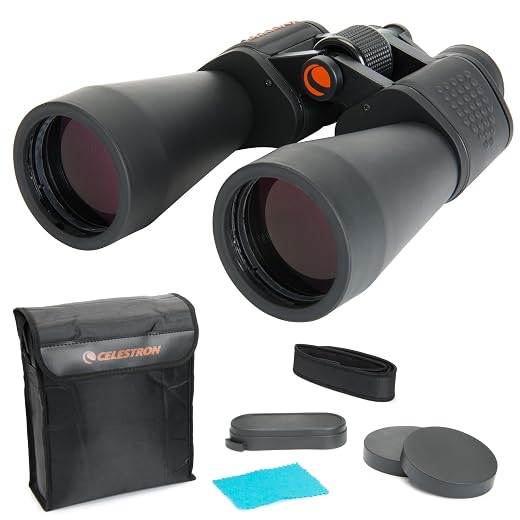
The Celestron SkyMaster 12×60 Binoculars for Astronomy offer a middle ground between large-chassis astronomical instruments and compact handheld glasses. Built with 60mm objective lenses and a moderate 12x magnification, these binoculars capture substantially more ambient light than 50mm entry optics while preserving a manageable physical profile. Multi-coated lens elements and BaK-4 Porro prisms ensure clear, color-faithful views across twilight horizons, star fields, and bright deep-sky targets.
The 12×60 configuration produces a well-proportioned 5.0-millimeter exit pupil alongside a relative brightness rating of 25. This yields a bright optical pipeline that matches the dilated pupils of observers under dark skies. Comfort is enhanced by an 18-millimeter eye relief, allowing wearers of corrective glasses to maintain a full sight picture without pressing against the eyecups. The rubber-armored, water-resistant chassis features a center focus mechanism. While the manufacturer notes this model can be operated handheld for shorter intervals, the chassis features tripod adaptability so users can connect a user-supplied adapter for long, motionless observing sessions.
This binocular caters to observers seeking an agile night-sky optic that delivers noticeable magnification without requiring an immediate, permanent commitment to a tripod setup. It provides greater reach than the Cometron 7×50 while remaining far less cumbersome than 70mm models. It concedes deep-space brightness, however, to the 15×70, which pulls in more raw light via its larger 70mm glass.
Pick 05
Celestron SkyMaster Pro 20×80 Astronomy Binoculars for Flagship Light Grasp

Best for: Serious amateur astronomers wanting premium optics
- Buyer rating
- 4.4 average left by Amazon buyers
- Brand
- Celestron
Pros
- Giant 80mm light gathering
- Proprietary XLT multi-coatings
- Waterproof and nitrogen purged
- Detachable RSR finder rail
Cons
- Substantial weight requires heavy tripod
- Shorter eye relief than 15×70
The Celestron SkyMaster Pro 20×80 Astronomy Binoculars represent the premium performance tier within Celestron’s Porro prism lineup, built specifically for dedicated amateur astronomers. Anchored by massive 80mm objective lenses and a powerful 20x magnification, these binoculars function essentially as two parallel astronomical refracting telescopes. Every glass-to-air surface is treated with Celestron’s proprietary XLT multi-coating technology, optimizing light transmission through high-grade BaK-4 prisms to yield high-contrast, razor-sharp images even under dim, low-light observing conditions.
Chassis engineering on the SkyMaster Pro advances beyond standard models. The structural body utilizes a rugged polycarbonate shell wrapped in protective rubber armor that is both fully waterproof and nitrogen-purged to stop internal fogging during cold, dew-heavy nights. The central bridge incorporates a specialized, detachable Reflex Sight Ready (RSR) rail that accommodates optional red-dot finderscopes for rapid celestial targeting. With a 4.0-millimeter exit pupil, 15.5 millimeters of eye relief, and center focus control, the optical path is optimized for high-end night-sky viewing on a dedicated mount.
This flagship instrument suits advanced visual observers and dark-sky enthusiasts seeking deep-space light-gathering power without the setup complexity of a telescope mount. Because the 80mm barrels and reinforced frame carry significant physical weight, a heavy-duty photographic or video tripod is mandatory. For casual observers seeking portable convenience over maximum aperture, the SkyMaster 15×70 or 12×60 proves far easier to pack and manage.
Pick 06
Celestron SkyMaster 15-35×70 Binoculars with Zoom for Variable Magnification

Best for: Flexible magnification framing for variable targets
- Buyer rating
- 4.6 average left by Amazon buyers
- Brand
- Celestron
Pros
- Versatile 15x to 35x zoom
- Generous 20.3mm eye relief
- Tripod adapter rod included
- Water-resistant rubber armor
Cons
- Image dims at higher magnification
- Mandates tripod stability
The Celestron SkyMaster 15-35×70 Binoculars with Zoom introduce dynamic focal flexibility to Celestron’s 70mm chassis. By integrating an adjustable zoom lever, this binocular transitions smoothly from 15x magnification up to a commanding 35x maximum magnification. Paired with 70mm light-gathering lenses, multi-coated glass elements, and BaK-4 Porro prisms, this model enables observers to locate wide star groupings at lower power before zooming in to isolate specific celestial features or distant terrain.
The optical system delivers a 4.7-millimeter exit pupil at its baseline 15x setting, accompanied by a generous 20.3-millimeter eye relief that easily accommodates eyeglasses across extended viewing sessions. The water-resistant exterior features protective rubber armor and a center focus wheel for unified adjustments across both optical barrels. Due to the high magnification potential and physical balance of 70mm optics, Celestron includes a rigid quarter-twenty tripod adapter rod in the package to lock the binocular securely to photographic tripods.
This optic serves versatile observers who want the operational convenience of framing targets at multiple focal lengths without swapping optical equipment. It functions admirably for dual astronomical and long-range terrestrial scouting. However, because internal zoom assemblies divide light transmission more aggressively at higher powers compared to fixed optical paths, stargazers prioritizing pure edge-to-edge optical clarity across deep space will prefer fixed-power options like the SkyMaster 15×70 or 25×70.
How to Choose the Right Celestron Astronomy Binoculars
Selecting the best celestron binoculars for stargazing requires matching objective lens diameter, magnification level, and mounting expectations to your personal observing style. While daylight sports often rely on compact roof-prism designs like nikon compact binoculars, astronomical binoculars depend fundamentally on large objective apertures to gather photons from distant, low-contrast celestial bodies. Apertures of 50mm and 60mm provide an entry point that balances light gathering with lower weight, whereas 70mm and 80mm lenses gather dramatically more light to reveal faint nebulae and distant star clusters at the expense of portability.
Magnification determines both image scale and field of view. A lower magnification, such as the 7x found on the Cometron, creates an expansive view that stabilizes easily in unsupported hands, making it ideal for learning constellation patterns and tracking comets. Conversely, magnifications between 12x and 20x reveal intricate lunar topography and split tight double stars, but require steady bracing. Magnifications reaching 25x or the variable 35x ceiling of the zoom variant deliver incredible target detail, yet they narrow the visual window and heavily exaggerate minor hand tremors.
Optical coatings and prism materials dictate how much gathered light reaches your dark-adapted eyes. Unlike standard outdoor glass like vortex hd binoculars that prioritize daytime color rendering, astronomy binoculars celestron constructs use dense BaK-4 Porro prisms and multi-coated glass to preserve light throughput across deep-sky targets. The SkyMaster Pro takes this optical standard further by deploying proprietary XLT fully multi-coated optics and nitrogen-purged waterproofing, preventing internal condensation during rapid nighttime temperature drops.
Finally, consider how you intend to support your optic in the field. Handheld observing is practical with the Cometron 7x50mm and manageable for short stints with the SkyMaster 12×60. Once you step up to 70mm and 80mm models, the physical weight of large glass elements and high magnification make a solid photographic tripod essential. When doing a celestron astronomy binoculars comparison, check whether the model includes a tripod adapter rod or requires a separate adapter, ensuring your night-sky sessions remain stable, sharp, and physically comfortable.
FAQ
Can I handhold Celestron astronomy binoculars without using a tripod?
Handheld operation depends directly on the magnification and physical weight of the binocular. The Celestron Cometron 7x50mm is explicitly designed for steady, handheld use thanks to its lightweight frame and low 7x power. The SkyMaster 12×60 can be handheld for brief celestial sweeps, though prolonged sessions cause arm fatigue. Larger models, including the 15×70, 25×70, 15-35×70, and 20×80, are too heavy and powerful for steady handheld observation, requiring a photographic tripod to prevent visual shake.
What is the difference between SkyMaster and SkyMaster Pro models?
The standard SkyMaster models use water-resistant rubber-armored bodies, BaK-4 prisms, and multi-coated optics suited for general astronomy and terrestrial observation. The SkyMaster Pro 20×80 upgrades build quality with fully multi-coated lenses featuring proprietary XLT coatings, a rugged polycarbonate chassis, complete nitrogen-purged waterproofing, and an integrated Reflex Sight Ready rail designed for attaching red-dot finderscopes.
How does exit pupil affect night-sky observation in Celestron binoculars?
Exit pupil represents the diameter of the light beam exiting the eyepiece, calculated by dividing the objective lens diameter by the magnification. A large exit pupil, such as the 7.1mm beam on the Cometron 7x50mm, matches the dilated pupils of dark-adapted human eyes to deliver bright images across wide starfields. Higher-magnification binoculars, like the SkyMaster 25×70 with its 2.8mm exit pupil, produce darker background skies that enhance contrast on bright targets like the moon and major planets.
What type of tripod adapter is included with Celestron astronomy binoculars?
The SkyMaster 15×70, SkyMaster 25×70, and SkyMaster 15-35×70 include a dedicated quarter-twenty tripod adapter rod in the package that threads into the central bridge. The Cometron 7x50mm and SkyMaster 12×60 feature built-in threaded tripod adapter sockets, but require a user-supplied binocular tripod adapter to connect to standard photo tripod plates. The SkyMaster Pro 20×80 incorporates integrated mounting hardware suited for heavy-duty tripod heads.
Which Celestron astronomy binoculars to buy for spotting comets and the Milky Way?
For sweeping the Milky Way and tracking bright comets across wide sky regions, the Cometron 7x50mm is exceptional due to its expansive 6.6-degree angular field of view and high 50.41 relative brightness. If you prefer deeper light-gathering power on a tripod to resolve individual stars within open clusters and nebulae, the SkyMaster 15×70 serves as the premier all-around instrument.
Where these figures come from
Every number on this page is read from the Amazon product listing: the price, the list price it is compared against, the specifications and the star rating. The star rating is the average left by Amazon buyers, not a score awarded by this site, and no product here has been handled or measured by us. The award ribbons are calculated across the products in this guide only, and each one states the figure it was based on.