Gskyer 70mm Telescope vs. Stepping Up: The Stargazer Lineup Ranked
Gskyer has established itself as an accessible gateway into observational astronomy, engineering entry-level instruments for beginners, students, and tech enthusiasts eager to explore celestial viewing without technical friction. For visual hobbyists and entertainment fans who appreciate crisp optical fidelity, translating that curiosity to the night sky requires understanding how aperture, focal ratio, and mount mechanics…
Prices and specifications come from the Amazon listing. Scores are out of 10, based on listed specifications and buyer feedback — this site does not test products.
Awards Worked out automatically from the Amazon listings of the 4 products in this guide.
-
Highest rated

Gskyer 130EQ Professional Astronomical Reflector Telescope for Deep Sky Objects
Our score: 9.8/10 — the highest of the 4 scored in this guide
As Amazon Associates, we earn from qualifying purchases. This means we may receive a small commission at no extra cost to you if you click through and make a purchase.
Gskyer has established itself as an accessible gateway into observational astronomy, engineering entry-level instruments for beginners, students, and tech enthusiasts eager to explore celestial viewing without technical friction. For visual hobbyists and entertainment fans who appreciate crisp optical fidelity, translating that curiosity to the night sky requires understanding how aperture, focal ratio, and mount mechanics dictate performance. The brand focuses on complete packages featuring multi-coated glass elements, interchangeable eyepieces, Barlow multiplication optics, and smartphone photography tools that simplify celestial documentation.
Across the modern Gskyer telescope lineup, optical capabilities divide between highly portable travel instruments like the popular Gskyer 70mm travel refractor and higher-aperture platforms engineered for enhanced resolution, ranging from extended focal-length refractors to an equatorial Newtonian reflector.
Gskyer Telescopes Compared
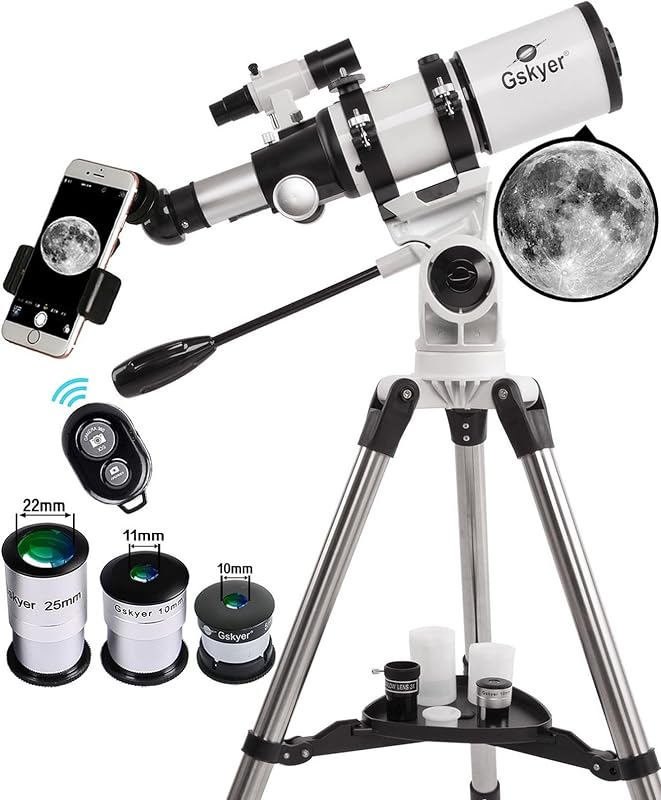
Best for: Observers seeking wide-field viewing with stainless stability
Pros
- Upgraded 80mm light-gathering front aperture
- Sturdy stainless steel adjustable tripod
- Higher quality BAK4 optical prism
Cons
- Shorter focal length limits native planetary scale
- Narrower 0.87-degree field of view

Best for: Mobile beginners prioritizing lightweight travel observing
Pros
- Extremely lightweight travel bag package
- Simple manual altazimuth panhead
- Smartphone adapter and wireless remote included
Cons
- Modest 70mm aperture limits deep-sky reach
- Basic aluminum tripod stability
| Model | Optical Design | Aperture | Focal Length | Mount Type |
|---|---|---|---|---|
| Gskyer Telescope | Refractor | 70 mm | 400 mm (f/5.7) | Altazimuth Mount |
| Gskyer Telescope 600x90mm AZ Astronomical Refractor | Refractor | 90 mm | 600 mm (f/6.7) | Altazimuth Mount |
| Gskyer Telescope | Refractor | 80 mm | 400 mm | Altazimuth Mount |
| Gskyer 130EQ Professional Astronomical Reflector Telescope | Reflector | 130 mm (5.1 inches) | 650 mm (f/5) | German Equatorial Mount |
Pick 01
Gskyer Telescope for Portable Stargazing
- Our score
- 9.0 out of 10
- Brand
- Gskyer
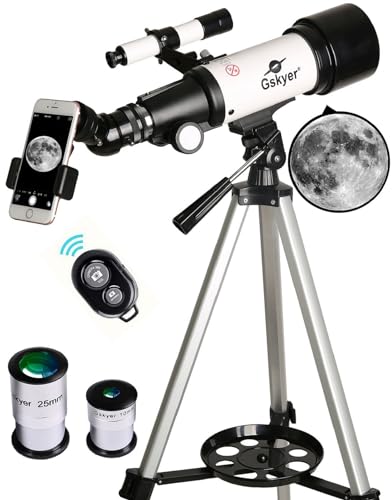
The Gskyer Telescope stands as the foundational optical system in the brand catalog, built for quick deployment and lightweight travel. Featuring a 70mm aperture and a 400mm focal length (f/5.7), this compact refractor utilizes fully coated optical glass lenses with high transmission coatings to produce bright, high-contrast imagery while protecting observer eyes. With an optical tube length of just 40 centimeters, the full optical assembly packs neatly into an included custom carry bag alongside an adjustable aluminum alloy tripod, making it an agile choice for backyard sessions and camping getaways.
Evaluating this system in a Gskyer 70mm telescope comparison highlights an accessory suite geared toward fast target acquisition. The refractor includes two replaceable eyepieces and a 3x Barlow lens that triples magnification power up to an effective 120x zoom ratio. Observers locate targets using a 5×24 finderscope with internal crosshairs, while an altazimuth panhead mount provides smooth manual pointing across a wide 5.8-degree field of view. Visual hobbyists can attach their mobile devices using the included smartphone adapter and wireless camera remote, capturing lunar details through their screen with a framing workflow reminiscent of using a sharp canon zoom lens.
This refractor is best for mobile beginners and casual stargazers who value lightweight transport and immediate setup for lunar tracking. Its compact 70mm aperture naturally yields to larger optical tubes when hunting faint nebulae or high-magnification planetary details.
Pick 02
Gskyer Telescope 600x90mm AZ Astronomical Refractor for Lunar Detail

Best for: Backyard lunar and planetary visual observers
- Our score
- 8.8 out of 10
- Brand
- Gskyer
Pros
- Generous 90mm aperture with crisp glass
- Long 600mm focal length for magnification
- Erecting BAK7 prism and astronomy software
Cons
- Heavier 17.5-pound optical assembly
- Longer tube less practical for transport
Stepping up in optical scale, the Gskyer Telescope 600x90mm AZ Astronomical Refractor provides an adult-focused observation platform built for greater resolution. Featuring a 90mm objective lens and an extended 600mm focal length (f/6.7), this refractor collects substantially more light than 70mm alternatives, providing sharp views of lunar crater rims and planetary disks. The 60-centimeter optical tube incorporates German technology design principles and multi-coated glass components, creating a dedicated assembly for steady backyard viewing.
The optical configuration of this Gskyer 600x90mm AZ refractor emphasizes visual versatility across planetary and terrestrial targets. The package includes three eyepieces (24x, 60x, and 120x) paired with a 3x Barlow lens for flexible magnification choices. A 6×30 reflex finderscope assists with object alignment, while a 48-degree erecting BAK7 prism provides correct-image orientation. The optical tube mounts to an adjustable aluminum tripod expanding from 31.5 inches to 49 inches, requiring no tools for assembly and including astronomy software to assist night sky navigation.
This refractor suits backyard observers seeking cleaner lunar contrast and brighter planetary disks without leaving the refractor category. Weighing 17.5 pounds, it trades away grab-and-go portability, stepping aside for large reflectors when faint deep-sky targets become the focus.
Pick 03
Gskyer Telescope for Wide-Field Performance

- Our score
- 8.2 out of 10
- Brand
- Gskyer
The 80mm edition of the Gskyer Telescope strikes an appealing balance between compact travel dimensions and increased light grasp. Built with an 80mm aperture inside a short 400mm focal length tube, this model gathers more light than entry-level 70mm designs while preserving a manageable 40-centimeter optical tube length. Its fully coated optical glass elements boost image brightness, delivering clear planetary and terrestrial viewing in a travel-friendly form factor.
This Gskyer 80mm AZ space telescope introduces notable hardware upgrades, most visibly through its adjustable stainless steel tripod with an integrated accessory tray for superior stability. The optical path incorporates an upgraded 48-degree erecting BAK4 prism for enhanced transmission alongside a 6×30 finderscope on a mounting bracket. Three replaceable eyepieces (25mm for 16x, 10mm for 40x, and 5mm for 80x) work with the included 3x Barlow lens across an 80 multiplier zoom ratio with a 0.87-degree field of view. The included phone attachment and Bluetooth camera remote let observers capture digital photos easily, offering an accessible optical setup comparable to pairing camera gear with cannon rf lenses for terrestrial imagery.
This model suits observers who want the physical footprint of a 400mm refractor backed by superior optical glass and stainless steel stability. It steps aside for longer focal refractors or wide reflectors when resolving fine planetary surface details.
Pick 04
Gskyer 130EQ Professional Astronomical Reflector Telescope for Deep Sky Objects
- Highest rated Our score: 9.8/10 — the highest of the 4 scored in this guide

Best for: Stargazers targeting faint nebulae and star clusters
- Our score
- 9.8 out of 10
- Brand
- Gskyer
Pros
- Large 130mm aperture mirror light bucket
- German equatorial mount for celestial tracking
- High 307x maximum magnification capability
Cons
- Steeper learning curve for polar alignment
- Bulky assembly requires more setup time
Serving as the optical flagship, the Gskyer 130EQ Professional Astronomical Reflector Telescope swaps refractor glass for a Newtonian reflector system. Built around a 130mm (5.1-inch) aperture and a 650mm focal length with a fast f/5 focal ratio, this reflector gathers dramatically more light than any refractor in the lineup. Its 24-inch optical tube uses all-glass optical components with high transmission coatings, making it capable of revealing lunar relief, planetary structures, star clusters, brighter galaxies, and nebulae.
This Gskyer 130EQ reflector telescope introduces precise celestial tracking via its German equatorial mount (EQ-130). Once polar-aligned with the celestial pole, observers can track drifting night-sky objects smoothly along a single rotational axis using manual controls. The tube features a toothless focusing base for smooth adjustments, an included reflex finderscope, three eyepieces, a 3x Barlow lens reaching up to 307x maximum magnification, and a wireless Bluetooth remote compatible with mobile devices without extra apps.
This reflector stands as the best Gskyer telescope for deep-sky exploration, rewarding stargazers and tech enthusiasts who want serious light gathering. Because the equatorial mount requires polar alignment, it demands more setup patience than altazimuth refractors, but delivers visual reach that smaller lenses cannot match.
How to Choose the Right Gskyer Telescope
Choosing the right model begins with evaluating Gskyer refractor vs reflector optical architectures. Refractors feature sealed tubes that require no optical maintenance, providing upright visual images suitable for both astronomy and daytime spotting. In contrast, Newtonian reflectors like the 130EQ use open optical tubes with primary mirrors designed purely for celestial gathering, maximizing raw light intake at the expense of terrestrial utility.
Aperture and focal length dictate resolving power and field of view. The 70mm and 80mm refractors use 400mm focal lengths to provide wide star fields, making them ideal for lunar viewing and sweeping constellations. The 90mm refractor extends to a 600mm focal length, delivering narrower fields and higher native magnification for planetary detail. Meanwhile, the 130mm reflector maximizes light collection, brightening faint nebulae and star clusters.
Mount mechanics determine your operational workflow. Altazimuth mounts on the 70mm, 80mm, and 90mm refractors pan horizontally and vertically like camera tripods, offering zero-friction operation. The German equatorial mount on the 130EQ requires polar alignment but simplifies celestial tracking along a single axis. Stargazers who also experiment with camera optics such as canon eos lenses will appreciate how mount rigidity directly preserves image sharpness.
When deciding which Gskyer telescope to buy, balance portability against optical ambition. Mobile observers should favor the lightweight 70mm or 80mm refractors, while stationary backyard stargazers will find the 90mm refractor or 130EQ reflector far more rewarding.
FAQ
What is the difference between the Gskyer 70mm and 80mm refractors?
Both refractors share a 400mm focal length and 40-centimeter tube, but the 80mm version captures more light through its larger objective lens. The 80mm model also upgrades to an adjustable stainless steel tripod, an improved BAK4 prism, and three eyepieces instead of two.
How does an altazimuth mount differ from a German equatorial mount?
An altazimuth mount pans up, down, left, and right like a camera tripod, making it intuitive for beginners. A German equatorial mount, used on the 130EQ, aligns with Earth’s rotational axis so observers can track moving celestial objects by rotating a single slow-motion control.
Can you capture photos through these Gskyer telescopes with a smartphone?
Yes, several models include a smartphone adapter bracket and a Bluetooth wireless camera remote. Clamping your phone over the eyepiece allows you to record photos and video of the Moon and bright planets without touching the tube.
Why choose a reflector telescope over a refractor model?
Reflector telescopes use mirrors rather than glass lenses, enabling larger light-gathering apertures in manageable tube lengths. The 130mm reflector gathers far more light than refractor lenses, bringing faint nebulae and star clusters into visual reach.
What celestial objects can you observe with the entry-level Gskyer 70mm travel refractor?
The 70mm refractor easily displays lunar craters, maria plains, Venusian phases, Jupiter and its four Galilean moons, and bright open star clusters like the Pleiades. Resolving fine planetary details or faint nebulae requires stepping up to the 90mm refractor or 130EQ reflector.
Where these figures come from
The price, the list price it is compared against and the specifications on this page are read from the Amazon product listing. Scores are out of 10, based on listed specifications and buyer feedback, and no product here has been handled or measured by us. The award ribbons are calculated across the products in this guide only, and each one states the figure it was based on.


