Uniden DFR7 Laser/Radar Detector vs Uniden R1 Extreme Long: Spec Comparison
Compare Uniden DFR7 and R1 Extreme Long specs. Check display clarity, physical size, and detection features to choose the best detector for your vehicle needs.
Prices and specifications come from the Amazon listing. Scores are out of 10, based on listed specifications and buyer feedback — this site does not test products.
As Amazon Associates, we earn from qualifying purchases. This means we may receive a small commission at no extra cost to you if you click through and make a purchase.
As an Amazon Associate we earn from qualifying purchases. Links on this page are affiliate links.
Comparing the uniden dfr7 laser radar detector vs uniden r1 extreme long helps you pick the right tool for your car. Both units offer 360-degree detection for radar and laser signals. They both use voice alerts to keep your eyes on the road. They also include built-in GPS for location-based filtering. The main difference lies in their display technology and specific filtering features. The DFR7 includes an OLED screen for detailed data. The R1 focuses on digital signal processing and quiet ride modes. You need to decide which interface suits your driving style.
Display Type
OLED display showing frequency, signal strength, and voltage
Not listed
GPS Features
GPS mute memory and camera alerts
Red light camera alerts
Filtering Technology
Advanced K/KA band filtering for blind spot systems
360-degree digital signal processor
Dimensions
8.25L x 2.7W x 7H inches
8.3L x 7W x 3.2H inches
Weight
1.1 pounds
1.1 pounds
Choose the first if
- You want an OLED display to see signal strength and battery voltage
- You need advanced filtering for blind spot monitoring false alerts
- You prefer GPS mute memory to silence repeated false alarms
Choose the second if
- You prioritize a compact vertical form factor for your windshield
- You want a unit focused on digital signal processing
- You prefer a simpler interface without a dedicated display screen
Verdict
Choose the DFR7 if you value visual feedback and advanced false alert filtering for modern vehicle systems. Pick the R1 if you prefer a streamlined design with digital signal processing and do not need a display. Both provide essential voice alerts and GPS camera data.
DFR7 vs R1 Spec Comparison
Display clarity
Edge: Uniden DFR7 Black Radar Detector
The Uniden DFR7 features an OLED display that shows radar band frequency, numeric signal strength, maximum speed warnings, and vehicle battery voltage. This provides detailed, real-time data while you drive. The Uniden R1 data does not list a display type or screen specifications. Without a visible interface, you cannot see signal strength numbers or battery status directly on the unit. If you prefer visual confirmation of alerts and system status, the DFR7’s screen offers clear advantages over the R1, which relies on audio cues alone.
False alert filtering
Edge: Uniden DFR7 Black Radar Detector
The DFR7 includes advanced K/KA band filtering designed to avoid false alerts from blind spot monitoring and collision avoidance systems in other vehicles. It also uses GPS mute memory to remember and silence common false alerts like retail store automatic doors on your regular routes. The R1 data mentions a Digital Signal Processor and quiet ride features but does not explicitly list advanced K/KA filtering or GPS mute memory for retail doors. The DFR7 provides more specific details on how it handles modern vehicle interference and location-based muting.
Camera alerts
Edge: Tie
Both detectors include GPS technology for red light and speed camera alerts. The DFR7 specifies that these locations are preloaded and updated via free database and firmware updates, ensuring the detector remains current. The R1 data confirms GPS with red light camera alerts but does not mention the update mechanism or speed camera coverage explicitly. Both units offer essential camera alert protection, but the DFR7 provides clearer information regarding how the alert database is maintained and expanded over time.
Physical dimensions
Edge: Tie
The Uniden DFR7 measures 8.25 inches in length, 2.7 inches in width, and 7 inches in height. The Uniden R1 measures 8.3 inches in length, 7 inches in width, and 3.2 inches in height. Both units weigh 1.1 pounds and come in black. The DFR7 is narrower but taller, while the R1 is wider but significantly shorter. Your choice may depend on how you plan to mount the device, as the DFR7 has a vertical profile and the R1 has a horizontal, low-profile shape.
Alert customization
Edge: Tie
The DFR7 allows you to program voice alerts to fit your driving style, ensuring clear communication without distraction. It also includes mute memory for false alerts. The R1 data mentions voice alerts and a quiet ride user-set speed auto mute feature, which likely allows you to set a speed threshold for muting certain alerts. Both units offer voice-based notifications, but the DFR7 explicitly highlights programmable voice alert styles, while the R1 focuses on speed-based muting. Both approaches help you stay informed without excessive noise.
Which Uniden Detector Fits You
Drivers wanting detailed dashboard info
Our pick: Uniden DFR7 Black Radar Detector
The Uniden DFR7 includes an OLED display showing radar band frequency, numeric signal strength, and vehicle battery voltage. This visual data helps you monitor your system status in real time. The Uniden R1 does not list a display, so you rely solely on voice alerts. If you prefer seeing signal details, the DFR7 is the better choice for your cockpit.
Commuters needing route-based muting
Our pick: Uniden DFR7 Black Radar Detector
The Uniden DFR7 uses GPS mute memory to remember and silence common false alerts on your regular routes. It also provides preloaded red light and speed camera locations with free updates. The Uniden R1 lists red light camera alerts but does not mention route-specific mute memory. If you drive the same roads daily, the DFR7 reduces noise effectively.
Those prioritizing compact size
Our pick: Uniden R1 Black Radar Detector
The Uniden R1 measures 7 inches wide by 3.2 inches high. The Uniden DFR7 is 2.7 inches wide but 7 inches high. Both units weigh 1.1 pounds. The R1 has a lower profile vertically. If you want a detector that sits flatter on your dash, the R1 dimensions offer a smaller footprint. The DFR7 is taller.

Uniden DFR7 Black Radar Detector
Best for: drivers needing GPS mute memory and voice alerts
- GPS Features
- GPS mute memory, camera alerts
- Detection Coverage
- 360° protection, radar and laser
- Alert Types
- Voice alerts
- Display Type
- OLED
- Color
- Black
- Dimensions
- 8.25 × 2.7 × 7 inches
The Uniden DFR7 is a laser and radar detector with 360-degree protection. It uses GPS mute memory to filter false alerts from automatic doors. The OLED display shows signal strength and speed warnings. Voice alerts keep you informed without distraction. This model suits drivers who want wide-band sensitivity and preloaded camera locations for routine commuting.
- Wide-band protection against all radar and laser guns
- GPS mute memory for common false alerts
- OLED display shows numeric signal strength
- Preloaded red light and speed camera locations
- Voice alerts for hands-free operation
- Bulky dimensions of 8.25 x 2.7 x 7 inches
- Heavier build at 1.1 pounds
- You want GPS-based false alert filtering
- You prefer voice alerts over beeps
- You need 360-degree detection coverage
- You need a compact, low-profile unit
- You prefer a smaller form factor
- You want a lighter device under 1 pound
Verdict: Uniden DFR7 Long Range Detector offers solid wide-band sensitivity and GPS filtering for drivers who prioritize feature density over a small footprint.
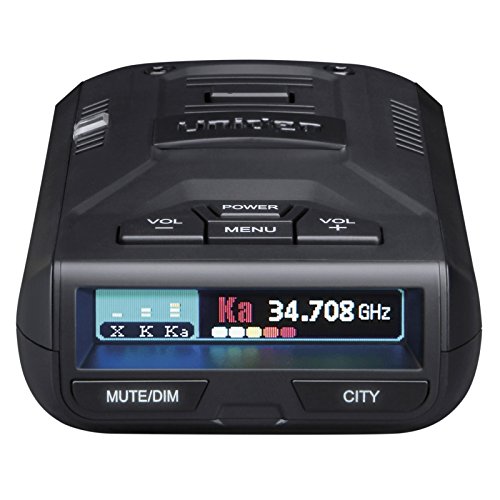
Uniden R1 Black Radar Detector
Best for: drivers prioritizing maximum detection range
- GPS Features
- Red light camera alerts
- Detection Coverage
- Radar, laser
- Alert Types
- Voice alert
- Color
- Black
- Dimensions
- 8.3 × 7 × 3.2 inches
- Weight
- 1.1 pounds
The Uniden R1 detector offers extreme long-range detection for radar and laser signals. It features a 360-degree digital signal processor and voice alerts to keep you informed. GPS provides red light camera alerts. Weighing 1.1 pounds, it is a substantial unit. This model suits drivers who prioritize maximum detection range and comprehensive 360-degree coverage over a compact footprint.
- Extreme long-range detection for radar and laser
- 360-degree digital signal processor for full coverage
- Voice alerts for clear notification
- GPS red light camera alerts
- Heavier build at 1.1 pounds compared to lighter competitors
- Larger dimensions measuring 8.3 inches in length
- You need extreme long-range detection capability
- You want 360-degree signal coverage
- You prefer voice alerts over text displays
- You require a lightweight device under 1 pound
- You need a compact unit smaller than 8 inches
- You prefer text-based alerts over voice
Verdict: Uniden R1 Extreme Long Range Detector delivers superior range and 360-degree coverage for drivers who value detection power over portability. It fits those who want voice alerts and GPS camera warnings in a robust, heavy-duty package.
Specifications side by side
| Spec | Uniden DFR7 Black Radar Detector | Uniden R1 Black Radar Detector |
|---|---|---|
| GPS Features | GPS mute memory, camera alerts | Red light camera alerts |
| Detection Coverage | 360° protection, radar and laser | Radar, laser |
| Alert Types | Voice alerts | Voice alert |
| Display Type | OLED | – |
| Color | Black | Black |
| Dimensions | 8.25 × 2.7 × 7 inches | 8.3 × 7 × 3.2 inches |
| Weight | 1.1 pounds | 1.1 pounds |
| Size | 8.25L x 2.7W x 7H inches | – |
| Model | DFR7 | R1DSP |
Frequently asked questions
Which Uniden detector is smaller and easier to hide?
The Uniden DFR7 measures 8.25 inches long, 2.7 inches wide, and 7 inches high. The Uniden R1 is slightly longer at 8.3 inches and taller at 3.2 inches, with a width of 7 inches. The DFR7 has a narrower profile, which may make it less noticeable on your windshield. Both units weigh the same at 1.1 pounds, so mounting weight is not a differentiating factor for you.
Does the Uniden DFR7 include built-in GPS?
Yes, the Uniden DFR7 comes with built-in GPS. This feature allows for automatic mute memory and speed camera alerts. The data for the Uniden R1 does not list GPS capabilities. If you need GPS-driven alerts for fixed cameras, the DFR7 is the suitable choice. The R1 focuses on detection range rather than location-based filtering features.
What is the main difference in display technology?
The Uniden DFR7 features an OLED display. This screen provides visual feedback on radar band frequency and signal strength. The Uniden R1 data does not mention a display type. You will rely on voice alerts for the R1 instead of visual indicators. The DFR7 offers more detailed visual information if you prefer watching your dashboard for signal details.
Are both detectors capable of 360-degree detection?
Yes, both the Uniden DFR7 and the Uniden R1 offer 360-degree detection. This means they can sense radar and laser signals from all directions around the vehicle. You do not need to worry about the direction of the signal source. Both units provide comprehensive coverage to ensure you are alerted regardless of where the enforcement vehicle is positioned relative to your car.
Which model is better for drivers who want voice alerts?
Both models support voice alerts to keep your attention on the road. The Uniden DFR7 also includes red light and speed camera alerts via its GPS. The Uniden R1 lists voice alerts as a primary feature. If you want additional camera warnings, the DFR7 is the better option. Both will notify you audibly when a signal is detected.
Is there a significant weight difference between the two units?
No, both detectors weigh exactly 1.1 pounds. The weight is identical for the Uniden DFR7 and the Uniden R1. This means the strain on your windshield mount or suction cup will be the same for either choice. You do not need to consider weight distribution when deciding between these two specific models. Both are robust enough to stay in place during normal driving.
See also
Where these figures come from
The price, the list price it is compared against and the specifications on this page are read from the Amazon product listing. Scores are out of 10, based on listed specifications and buyer feedback, and no product here has been handled or measured by us. The award ribbons are calculated across the products in this guide only, and each one states the figure it was based on.


