The Best Canon Telephoto Lenses for Sports and Action Ranked
Canon has long maintained a formidable reputation in sports arenas, sidelines, and wildlife reserves for producing optics that pair expansive focal reach with swift subject tracking. Photographers looking for a reliable tele lens canon setup require glass that isolates rapid motion, renders crisp details across long distances, and maintains stable framing during fast-paced sequences. Whether…
Prices and specifications come from the Amazon listing. Ratings are the average left by Amazon buyers — this site does not test products.
Awards Worked out automatically from the Amazon listings of the 6 products in this guide — no editorial scoring.
-
Highest rated

Canon EF 75-300mm f 4-5.6 III for Budget SLR Zooming
4.5★ average from Amazon buyers — the highest of the 6 rated in this guide
As Amazon Associates, we earn from qualifying purchases. This means we may receive a small commission at no extra cost to you if you click through and make a purchase.
Canon has long maintained a formidable reputation in sports arenas, sidelines, and wildlife reserves for producing optics that pair expansive focal reach with swift subject tracking. Photographers looking for a reliable tele lens canon setup require glass that isolates rapid motion, renders crisp details across long distances, and maintains stable framing during fast-paced sequences. Whether you are tracking athletes downfield or framing distant wildlife, choosing the best canon telephoto lens comes down to understanding how autofocus drive motors, optical coatings, and stabilization systems translate into real-world action performance.
The models in this guide differ primarily across their mount designs, focusing mechanisms, and stabilizing abilities, separating lightweight entry zooms from extended reach optics and specialized high-magnification primes.
Canon Telephoto Lenses Compared
| Model | Mount Compatibility | Focal Length | Autofocus Drive | Image Stabilization |
|---|---|---|---|---|
| Canon EF 75-300mm f 4-5.6 III (Renewed) | Canon EF | 75-300mm | DC Autofocus Motor | Optical |
| Canon RF100-400mm F5.6-8 is USM Telephoto | Canon RF | 100-400mm | Nano USM | Optical (up to 5.5 to 6 stops) |
| Canon EF 75-300mm f 4-5.6 III | Canon EF | 75-300mm | DC Autofocus Motor | No |
| Canon RF75-300mm F4-5.6 | Canon RF | 75-300mm | Servo AF capable | No |
| Canon EF 50mm f 1.8 STM | Canon EF | 50mm | Stepping Motor (STM) | No |
| High-Power 500mm 1000mm f 8 Manual | Canon EF | 500mm (1000mm with 2x) | Manual Focus | Digital |
Pick 01
Canon EF 75-300mm f 4-5.6 III for Budget SLR Zooming
- Highest rated 4.5★ average from Amazon buyers — the highest of the 6 rated in this guide

Best for: Entry DSLR users tracking distant sports
- Buyer rating
- 4.5 average left by Amazon buyers
- Brand
- Canon
Pros
- Smooth zooming mechanism
- Lightweight first optical group
- Compact 4.8-inch barrel length
Cons
- No optical image stabilization
- Basic DC focusing motor

Best for: Budget DSLR photographers wanting telephoto reach
Pros
- Lightweight 16.8-ounce build
- Super Spectra coating
- Listed optical image stabilization
Cons
- Slower DC autofocus motor
- Long 4.9-foot minimum focus distance
The renewed edition of the Canon EF 75-300mm f 4-5.6 III offers a 4:1 zoom ratio designed for traditional Canon SLR systems. It is engineered with a lightweight glass material in the first optical element group, which is traditionally the heaviest part of the assembly. By shaving weight from this forward optical section, the lens lessens the mechanical strain on the focusing motor during rapid focal adjustments. The physical barrel measures 2.8 inches in diameter and 4.8 inches in length, keeping the total carry weight to a manageable 16.8 ounces. For photographers who want to study field behavior before investing heavily, reading our canon telephoto lens comparison helps contextualize how older EF glass performs alongside newer systems.
This telephoto zoom covers a diagonal angle of view spanning from 32 down to 8 degrees, providing adequate framing tightness for field sports and outdoor track events. Optical glare is mitigated through Super Spectra Coating, which preserves contrast when stadium floodlights or bright sun angle into the front element. Mechanically, the lens integrates an improved zoom mechanism with a silver trim accent ring on the zoom collar, ensuring smooth transitions across the 75-300mm focal spread. It utilizes a 58mm front filter thread diameter and requires a minimum focusing distance of 4.9 feet from the target.
While this configuration lists optical image stabilization, its DC autofocus motor lacks the instant drive velocity found on modern ultrasonic lenses. Action photographers tracking erratic runners or fast-flying birds will notice the slower focusing motor speed compared to higher-tier action glass. It is best suited for beginners shooting outdoor sports under daylight conditions where shutter speeds remain high enough to mitigate sudden motion blur, but it gives way to native RF optics when used on modern mirrorless bodies.
Pick 02
Canon RF100-400mm F5.6-8 is USM Telephoto for High-Speed Mirrorless Tracking

Best for: Mirrorless sports and wildlife action shooters
- Buyer rating
- 4.0 average left by Amazon buyers
- Brand
- Canon
Pros
- Up to 6 stops coordinated stabilization
- High-speed Nano USM autofocus
- Versatile 100-400mm focal reach
Cons
- Narrow f/8 aperture at 400mm
The Canon RF100-400mm F5.6-8 is USM Telephoto represents a substantial technological jump for EOS R series mirrorless camera users seeking canon telephoto lenses for action. Built specifically for mirrorless lens mounts, this optic provides an expansive 100-400mm zoom spread while retaining a remarkably slim and portable exterior comparable in physical scale to a 70-300mm lens. Inside the barrel, a single Ultra Low Dispersion element works to suppress chromatic aberrations, while Canon Nano USM autofocus delivers near-silent, exceptionally swift focus acquisition that locks onto moving targets without hesitation.
Stability is paramount when tracking subjects at 400mm, and this lens features a built-in Optical Image Stabilizer capable of delivering up to 5.5 stops of shake correction on its own. When attached to an EOS R series camera body equipped with an In-Body Image Stabilizer, such as the EOS R5 or EOS R6, the coordinated stabilization system scales up to 6 stops of compensation. The lens also provides impressive close-range utility, achieving a minimum focusing distance of 2.89 feet at the 200mm focal position and a maximum magnification of 0.41x at 400mm, making it equally adept at capturing small sidelines action or distant subjects across a 61-degree field of view.
For sports and wildlife enthusiasts asking which canon tele lens to buy for mirrorless tracking, this optic is the definitive recommendation. The variable f/5.6-8 aperture means it requires ample daylight or elevated camera ISO values under twilight, but its autofocus agility and robust stabilization make it vastly superior to older variable zooms when capturing fast-moving vehicles, athletes, or running animals.
Pick 03
Canon EF 75-300mm f 4-5.6 III for Full-Range Outdoor Action

- Buyer rating
- 4.2 average left by Amazon buyers
- Brand
- Canon
The standard production Canon EF 75-300mm f 4-5.6 III is an authentic canon ef telephoto lens constructed for standard Canon SLR camera mounts. Built around an optical arrangement of 13 elements organized into 9 groups, this lens spans an aperture range from f/4 at the 75mm wide end to f/5.6 at the 300mm telephoto extreme. Like its renewed sibling, it relies on Super Spectra Coating to preserve optical clarity and limit ghosting caused by reflective light bouncing within the barrel. It carries a physical footprint measuring 2.8 inches wide by 4.8 inches long, weighing in at 16.8 ounces, and includes a 1-year warranty from the manufacturer.
This telephoto optic relies on a conventional DC motor rather than an ultrasonic motor to actuate the internal autofocus components. Its minimum focusing distance sits at 4.9 feet, with a diagonal angle of view shifting between 32 degrees and 8 degrees as you twist the zoom ring. The zooming ring incorporates an updated internal track design for smooth zoom transitions across the 4x magnification range, sporting a distinctive silver accent ring. If you frequently balance long telephoto field work with shorter documentary shooting, pairing this reach with a canon eos lens designed for wider viewpoints creates a versatile setup.
Crucially, this lens explicitly features no optical image stabilization. Without stabilization hardware in the barrel, shooting at 300mm requires steady handheld technique and rapid shutter speeds to prevent blurred sports frames. This optic suits hobbyist photographers documenting daytime Little League baseball, soccer, or outdoor track meets on an entry-level DSLR, but it gives way to the stabilized RF100-400mm when shooting handheld in dynamic, fast-moving environments.
Pick 04
Canon RF75-300mm F4-5.6 for Portable Mirrorless Telephoto Reach

Best for: EOS R mirrorless sports enthusiasts
- Buyer rating
- 4.3 average left by Amazon buyers
- Brand
- Canon
Pros
- Servo AF and pupil detection tracking
- Direct native RF mount integration
- Reach expands to 480mm on APS-C
Cons
- No built-in image stabilization
- Variable f/4-5.6 aperture
The Canon RF75-300mm F4-5.6 delivers dedicated telephoto framing directly to EOS R series mirrorless bodies without requiring mount adapters. Covering a focal length range of 75-300mm, it transforms into an effective 120-480mm equivalent field of view when mounted onto an APS-C crop mirrorless body. This extra crop reach pulls distant action directly to the center of the frame, allowing sports fans and nature spotters to fill the sensor with far-off subjects that physical boundaries prevent them from approaching.
A key operational benefit of this native RF lens is its complete integration with modern mirrorless autofocus algorithms. The lens is fully compatible with continuous Servo AF and pupil detection routines, sustaining accurate subject tracking even when pushed out to the 300mm focal extreme. At long focal lengths, the f/4-5.6 aperture profile produces pronounced telephoto compression and smooth background bokeh, isolating fast-moving competitors cleanly from cluttered spectator stands. Its real angle of view covers 32 degrees at the wider end.
The manufacturer listing specifies that this lens contains no built-in image stabilization. While the absence of optical stabilization requires users to rely on higher shutter speeds or in-body camera sensor stabilization, the lightweight build keeps gear bags nimble. This model suits enthusiast creators who want a dedicated canon zoom lens for sports on their EOS R body, serving as a practical stepping stone before stepping up to higher-magnification USM optics.
Pick 05
Canon EF 50mm f 1.8 STM for Low-Light Action and Portraits

Best for: Fast indoor action and portraits
- Buyer rating
- 4.4 average left by Amazon buyers
- Brand
- Canon
Pros
- Bright f/1.8 maximum aperture
- Quiet STM stepping motor
- Close 1.15-foot minimum focus distance
Cons
- Fixed 50mm focal length
- Lacks optical image stabilization
Although technically categorized as a standard prime, the Canon EF 50mm f 1.8 STM plays a pivotal tactical role for photographers capturing fast action in indoor courts and dimly lit arenas. Featuring an ultra-wide maximum aperture of f/1.8, this lens gathers over eight times more light than a standard kit zoom lens. That immense light transmission allows action shooters to freeze fast movement with high shutter speeds without introducing debilitating noise. On APS-C DSLR bodies, its 50mm focal length provides an 80mm effective angle of view, shifting its framing directly into moderate telephoto territory.
Autofocus actuation is handled by Canon stepping motor (STM) technology, delivering near-silent and fluid continuous Servo AF operation for both high-speed still bursts and video capture. The internal construction consists of 6 elements in 5 groups treated with multicoating to counter internal flare. It achieves an exceptionally tight minimum focusing distance of just 1.15 feet (0.35 meters) and a maximum magnification factor of 0.21x, making it equally effective for close-up sports portraits, sideline reactions, and indoor gym action. Photographers exploring different focal perspectives can contrast this compact prime against a wide field of view using a canon rf wide angle lens.
The lens does not contain image stabilization, but its wide f/1.8 aperture substantially offsets that absence by keeping exposure times rapid. It lacks the long-range reach required to pull a distant soccer play into close view, meaning it cannot replace a 300mm or 400mm telephoto zoom. Instead, it serves as an indispensable close-range companion for low-light gymnastics, basketball, and evening field celebrations where long telephoto lenses simply let in too little ambient light.
Pick 06
High-Power 500mm 1000mm f 8 Manual for Extreme Distance Capture
Best for: Extreme distance and celestial telephoto captures
- Buyer rating
- 4.3 average left by Amazon buyers
- Brand
- Big Mike's
Pros
- Massive reach up to 1000mm
- Includes 2X teleconverter
- Durable metal exterior finish
Cons
- Fully manual focus and aperture
- Narrow fixed f/8 aperture
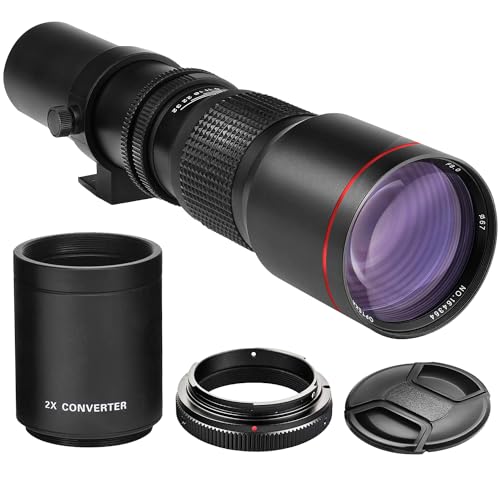
When physical sidelines place you hundreds of yards away from your subject, the High-Power 500mm 1000mm f 8 Manual offers extreme focal magnification. Designed for direct attachment to Canon EF-mount DSLR cameras, this optic starts as a 500mm f/8 telephoto prime. The package includes a dedicated 2X teleconverter that doubles the optical focal length up to an astounding 1000mm. Built to handle rugged outdoor elements, the lens barrel features a durable exterior finish and high-index, low-dispersion multi-coated optical glass engineered to keep distant images detailed.
At 1000mm, the real angle of view constricts to a narrow 5 degrees, focusing entirely on isolated details across massive expanses. Unlike automatic zooms, this system utilizes entirely manual focus and manual aperture operation. This hands-on mechanical control provides complete creative authority to set focus thresholds on stationary targets, distant nest perches, or track bends. The specifications list digital image stabilization integration within camera systems to assist in keeping the radical telephoto viewpoint steady.
The fully manual operation and fixed f/8 optical transmission create distinct workflow limitations. Because there is no electronic autofocus drive, tracking erratic, high-speed subjects requires manual pre-focusing on a specific point of the track or field. This lens is poorly suited for sudden, unpredictable action, giving way completely to the Nano USM tracking of the RF100-400mm. It is best reserved for patient photographers capturing predictable long-range action, distant wildlife, and astronomical events from a sturdy tripod.
How to Choose the Right Canon Telephoto Lenses
Selecting the ideal telephoto glass for action and sports requires aligning optical specifications with your camera body type, lighting conditions, and the distance between your vantage point and the subject. Here are the primary considerations to balance before securing your next lens:
- Mount Compatibility: Canon separates its lineup between the classic EF mount for DSLRs and the modern RF mount for mirrorless EOS R cameras. While EF lenses can adapt to mirrorless bodies, native RF options like the Canon RF100-400mm F5.6-8 is USM provide direct communication with advanced camera autofocus chips.
- Autofocus Motor Velocity: Sports photography demands instant focus acquisition. Motors vary widely: basic DC motors found in the Canon EF 75-300mm f 4-5.6 III deliver utilitarian focusing; stepping motors (STM) offer smooth, quiet tracking; and Nano USM systems provide the near-instantaneous tracking speeds required for erratic athletes and running wildlife.
- Image Stabilization Support: Handholding a telephoto lens at 300mm or 400mm magnifies even subtle hand tremors. Optic-based stabilization, seen in the RF100-400mm with up to 6 stops of coordinated correction, lets you track subjects smoothly without relying strictly on a monopod or tripod.
- Aperture and Light Transmission: Variable zooms stretching to f/5.6 or f/8 perform best in bright daylight. If your primary action coverage takes place indoors or under night floodlights, a fast prime like the EF 50mm f/1.8 STM lets in significantly more light to keep shutter speeds above motion-blur thresholds.
- Focal Reach and Flexibility: A 75-300mm zoom provides versatile reframing as plays move toward or away from your position. Conversely, super-telephoto reach like the 500mm/1000mm manual prime pulls in extreme distances but limits flexibility once subjects move closer.
FAQ
Can I use Canon EF telephoto lenses on newer Canon mirrorless cameras?
Yes, Canon EF telephoto lenses can be mounted onto Canon EOS R series mirrorless bodies by using an EF-to-RF mount adapter. The physical glass and internal motors remain identical, retaining autofocus and auto-exposure functions as supported by the camera body.
Is image stabilization essential for shooting sports with a telephoto lens?
While image stabilization is not strictly mandatory if you shoot at extremely high shutter speeds such as 1/1000s or faster, it greatly stabilizes the viewfinder image when framing distant athletes. Stabilized lenses like the RF100-400mm prevent hand jitter from ruining compositions, particularly during panning sequences.
Why does the aperture change when zooming on lenses like the 75-300mm?
Variable aperture zoom lenses adjust their maximum physical opening as the internal optical groups move. At the wider 75mm end, the maximum aperture is f/4, but extending the barrel to 300mm narrows the maximum aperture to f/5.6, letting in less light and requiring a higher ISO or brighter ambient conditions.
What does the STM designation mean on Canon lenses?
STM stands for Stepping Motor technology. It is an autofocus motor mechanism engineered to provide smooth, near-silent focusing transitions. This makes STM lenses, such as the EF 50mm f/1.8 STM, well suited for tracking moving subjects during video recording and capturing still action without disturbing ambient noise.
How does an APS-C crop sensor affect telephoto focal length?
When an optic is attached to a Canon camera equipped with an APS-C sensor, the smaller sensor size crops the center of the image circle, creating a 1.6x magnification field of view factor. For instance, a 75-300mm lens mounted on an APS-C body behaves with the equivalent framing reach of an approximate 120-480mm lens.
Where these figures come from
Every number on this page is read from the Amazon product listing: the price, the list price it is compared against, the specifications and the star rating. The star rating is the average left by Amazon buyers, not a score awarded by this site, and no product here has been handled or measured by us. The award ribbons are calculated across the products in this guide only, and each one states the figure it was based on.